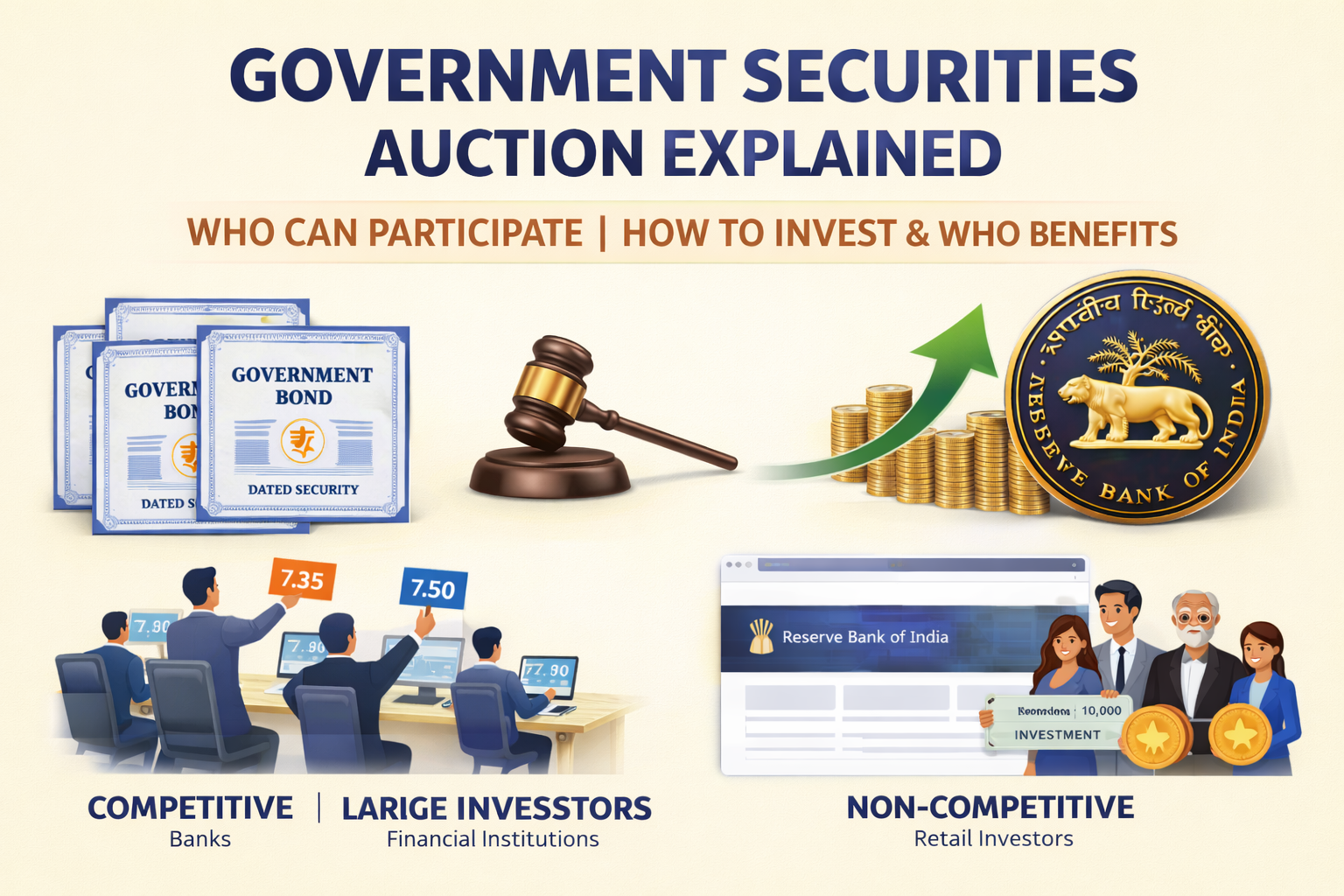
Synopsis: The Government of India has announced the re-issue of dated securities worth Rs. 29,000 crore. Government securities are sold through RBI auctions. Here is a simple explanation of what a government securities auction is, who can participate, how to participate, and who benefits from it.
What Is an Auction of Government Securities?
An auction of Government Securities (G-Secs) is a process through which the Government of India borrows money from the market.
Instead of taking loans from banks directly, the government issues bonds (dated securities). Investors buy these bonds and receive:
- Fixed interest (coupon payments)
- Return of principal at maturity
The Reserve Bank of India (RBI) conducts these auctions on behalf of the Government of India.
Why Does the Government Conduct These Auctions?
The government conducts G-Sec auctions to:
- Finance fiscal deficit
- Fund infrastructure projects
- Support development programs
- Manage public debt efficiently
In this case, the government plans to raise Rs. 29,000 crore through re-issue of two dated securities.
Types of Government Securities Auction
There are mainly two auction methods:
- Multiple Price Auction: Successful bidders get securities at their quoted yield/price.
- Uniform Price Auction: All successful bidders get securities at the same cut-off yield/price.
For re-issued securities, auctions are generally price-based.
Who Can Participate?
1. Competitive Bidders
These include:
- Banks
- Insurance companies
- Mutual funds
- Primary Dealers (PDs)
- Large financial institutions
They quote the yield or price at which they are willing to buy.
2. Non-Competitive Bidders
This category is meant for:
- Individual investors
- Small institutions
- Retail participants
Up to 5% of the notified amount is reserved for non-competitive bidding.
These bidders do not quote yield. They receive allotment at the weighted average yield decided in the auction.
How to Participate?
For Banks & Institutions
Participation is done electronically through RBI’s Core Banking Solution (e-Kuber system).
For Retail Investors
Individuals can participate through:
- RBI Retail Direct Portal (https://rbiretaildirect.org.in)
- Through banks or Primary Dealers
Minimum investment amount:
- Rs. 10,000
- In multiples of Rs. 10,000 thereafter
What Is “When Issued” Trading?
When Issued (WI) trading allows investors to buy and sell the securities before they are officially issued.
In this case, WI trading is allowed from March 04 to March 06, 2026.
Who Benefits from Government Securities?
Government Benefits
- Raises funds at market-determined interest rates
- Ensures transparent borrowing
Investors Benefit
- Low-risk investment (sovereign guarantee)
- Stable interest income
- Portfolio diversification
- Liquidity through secondary market trading
Banks & Financial Institutions Benefit
- Meet Statutory Liquidity Ratio (SLR) requirements
- Earn safe returns
- Use as collateral for borrowing from RBI
What Is Additional Competitive Underwriting (ACU)?
Primary Dealers can bid for underwriting commitments. This ensures:
- Full subscription of the government borrowing
- Stability in debt markets
Conclusion
Government securities auctions are a key tool for public borrowing. They are conducted transparently by RBI using electronic platforms. Both large institutions and retail investors can participate.
For conservative investors looking for stable and sovereign-backed returns, G-Secs are considered one of the safest investment options.
📌 Key Takeaway
Government securities auctions help the government raise funds while offering investors a safe, sovereign-backed investment option. Retail investors can now participate directly through the RBI Retail Direct portal with a minimum investment of Rs. 10,000.