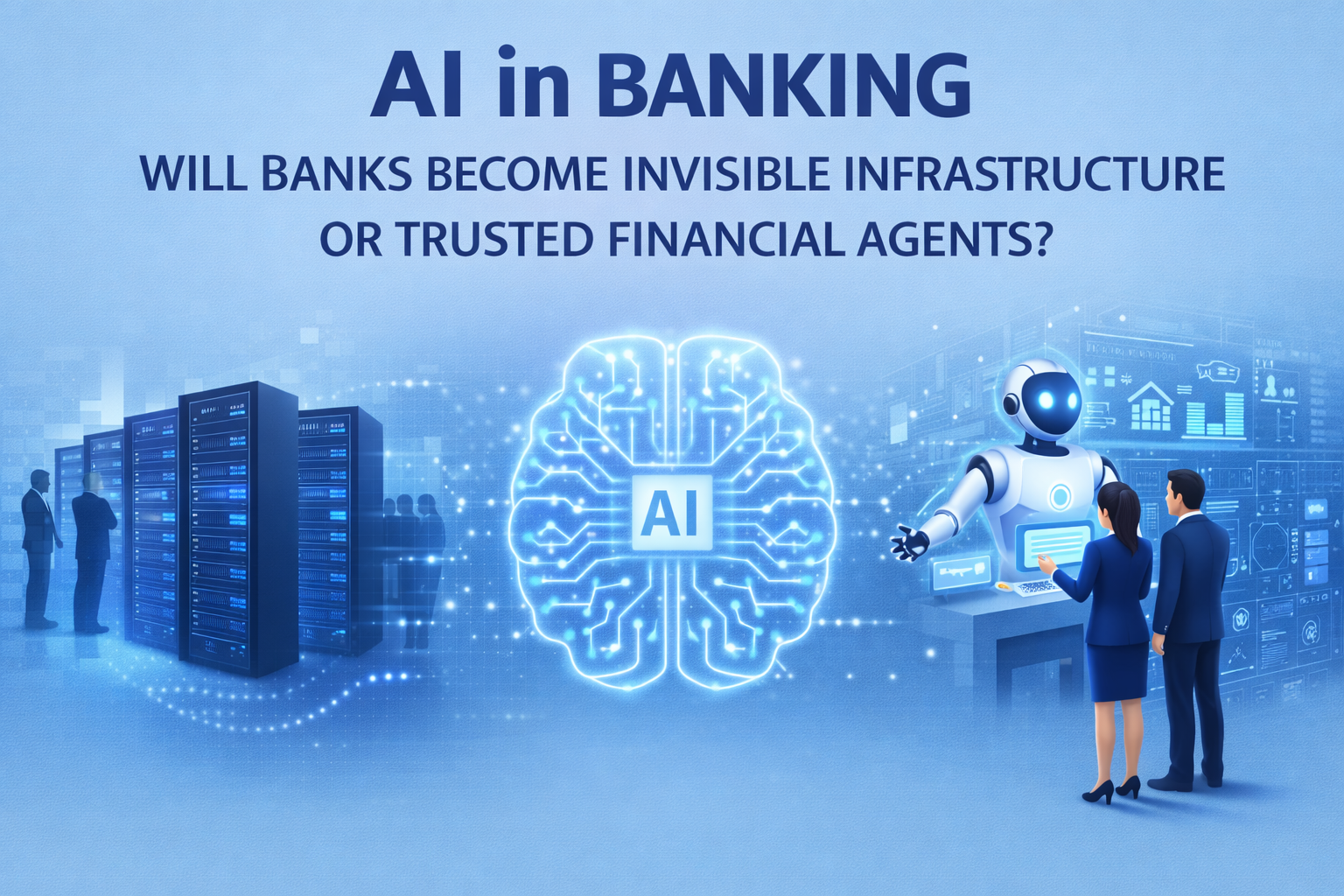
Synopsis: As artificial intelligence reshapes financial services, banks face a strategic choice: operate as an invisible integration layer within AI ecosystems or become a trusted AI-driven relationship platform. The future of banking will depend on how institutions embed themselves into AI-led decision-making at the point of customer intent.
Two Strategic Paths for Banks in an AI-Driven World
Banks now face two distinct strategic directions in an AI-mediated financial ecosystem.
1. Operate as an Integration Layer
The first approach is to function as an integration layer within emerging AI ecosystems.
In this model, banks ensure their products, payments, and capabilities are fully discoverable by:
- Exposing high-quality APIs
- Providing structured data
- Enabling real-time decisioning
This strategy prioritizes reach and operational efficiency. However, the brand may become largely invisible to the end customer.
Value is captured through:
- Transaction volume
- Operational efficiency
- Balance-sheet strength
Customer intimacy becomes secondary to scale and infrastructure strength.
2. Become a Relationship Platform
The second strategy focuses on owning the customer interface.
Here, the bank acts as a trusted financial agent on behalf of the customer. Using generative AI, banks deliver:
- Deeply personalized experiences
- Intelligent financial guidance
- Decision optimization
- Long-term trust building
This path preserves differentiation and loyalty but requires significant investment in:
- AI-native user experience (UX)
- Advanced data intelligence
- Operating-model transformation
Both approaches can succeed, but not every institution can execute both effectively.
Avoiding the choice is no longer viable.
Strategic Imperative: Redefining the Digital Assistant
AI disruption presents both risk and opportunity.
To remain relevant, banks must decide:
- Where AI should directly manage customer interactions
- How seamlessly services integrate into AI ecosystems
- How products are surfaced in AI-led discovery and search
This requires reimagining the bank’s digital assistant across seven critical dimensions:
- Intent-driven: Present at the moment of customer intent
- Context-aware: Understanding needs and behaviors
- Multi-modal: Across voice, text, and digital interfaces
- Agentic: Taking action on the customer’s behalf
- Revenue-generating: Through intelligent recommendations
- Open & connected: Integrated with broader ecosystems
- Proactive: Delivering timely and targeted support
When executed effectively, these capabilities can:
- Enhance customer experience
- Reduce cost to serve
- Strengthen long-term loyalty
- Create diversified revenue streams
Conclusion: Winning at the Moment of Intent
The future of banking will not be determined by who has the best mobile app or the largest balance sheet.
It will be determined by who shapes decisions at the moment intent is expressed.
In an AI-driven world, banks will not lose relevance because their products are inferior. They will lose relevance if they are absent when choices are made.
Institutions that fail to embed themselves within AI decision loops risk becoming invisible.
Those that succeed will ensure that when AI acts on behalf of customers, it acts with them — not around them.
📌 Key Takeaway
Banks must choose whether to power AI ecosystems from behind the scenes or own the customer relationship at the point of intent. In an AI-mediated financial world, visibility at the decision moment will determine long-term relevance.